The Ukrainian “Repressed” Cassandra: Tapestries by Stefaniia Shabatura
Oksana Levytska is Associate Professor at the Department of Philology at the Ukrainian Catholic University and the Department of Applied Linguistics at Lviv Polytechnic National University. She is a co-founder of the Intermedial Studies Platform, a literary critic, and an editor. Her research focuses on literature and art, the publishing market, and the relationship between literature and visual arts. She is the author of Contextuality of Chronotope. John Fowles’s The French Lieutenant’s Woman (Lviv, 2014) and more than 80 articles in literary criticism, publishing studies, and book reviews, as well as popular articles.
One of the most powerful images of the Trojan prophetess, Cassandra, in Ukrainian art is embodied in the Cassandra tapestry by Stefaniia Shabatura (1938–2014), created in 1971 during the Soviet occupation. Inspired by Lesya Ukrainka’s dramatic poem,1 this monumental work had such an impact on the totalitarian system that it became one of the reasons for the artist’s five-year imprisonment and three-year exile. In 1972, the tapestry maker was arrested by the Committee for State Security of the USSR, and Cassandra was used as evidence of anti-Soviet nationalistic activities.
In her study of the artist who fell victim to the “great purge” of the 1970s (Vasyl Ovsiienko refers to this as the “collapse” or “mowing”2), Liubov Krupnyk notes that this was a time of the largest-scale repression in the post-Stalin period. This period emerged as a result of a change in the political course in Ukraine in the second half of the 1960s, in particular following the decision of the Politburo of the Central Committee of the Communist Party of the Soviet Union of 30 January 1971 on the launch of a campaign against dissidents and samvydav publications.3 Shabatura, along with nearly two dozen other people, fell victim to a wave of arrests on January 12-13, 1972, suspected of anti-Soviet agitation and propaganda. Even before the court’s decision, Shabatura’s name was removed from the Dictionary of Artists of the Ukrainian SSR. She was also expelled from the Artists’ Union and, in July 1972, she was sentenced to five years imprisonment in a strict regime labor colony and three years exile, which she served first in the Kurgan region and then in the Mordovian strict regime camp for female political prisoners.
The tapestry Cassandra was confiscated during a search, along with the tapestry Lesya Ukrainka and hundreds of the artist’s bookplates and drawings. This article offers a detailed analysis of the reasons why this monumental work caused special concern among the servants of the totalitarian system, particularly concerning its content, color scheme, ideological message, Ukrainian national motifs, and especially the quotations from the works of Lesya Ukrainka. The aim of the article is to analyze the image of the Trojan prophetess Cassandra depicted on the tapestry of the Ukrainian dissident artist Shabatura. The article shows that the tapestry is a symbol of resistance against the Soviet totalitarian system and highlights the power of a visual image inspired by a dramatic poem to reactivate public consciousness.
Timely return to myth
The oldest surviving images show that artists have often turned to the figure of Cassandra, and some of the earliest artistic depictions of the Trojan princess, priestess, and prophetess can be found on ancient frescoes, bas-reliefs, amphorae, and others. The second chapter of the 2023 edition Cassandra. Literary and Visual Images,4 published in Italy, explores the evolution and significance of the images of Cassandra in Greek, Etruscan, and Roman art, including ancient iconography on frescoes, scenes of rape on ceramics, images of the prophetess in sanctuaries and tombs, among others. Notably, the image of Priam’s most beautiful daughter is examined through the concepts of beauty, sensuality, and femininity in the visual arts of antiquity, as well as the relationship between nudity and beauty.5 The figure of Cassandra has been analyzed in Pompeian painting, which illustrates the assimilation of the heroine into Roman culture, emphasizing the dramatic nature of the fall of Troy, scenes of conflict and prophecies.6 Just like in literary arts, Cassandra is not the central figure in the visual plots of the Trojan cycle of myths, yet she is endowed with expressive symbolism, through which particular meanings, ideas, and signals are conveyed.
Gabriel Zuchtriegel, director of the Pompeii Archaeological Park, where a new fresco depicting Cassandra and Apollo was discovered in 2024, notes that the scenes depicted on the frescoes performed have not only decorative, aesthetic and entertainment functions, but also a social function, as their stories prompted conversation during banquets and discussions of important topics in high society. Gabriel Zuchtriegel states that
These days, Helen and Paris represent us all: each day we can choose whether to focus solely on our own private lives or whether to explore the way our lives are entangled with the broad sweep of history, thinking for example, not just of war and politics, or of the environment, but also of the atmosphere we are creating in our society, communicating with others in real time and on social networks.7
The Trojan War and its heroes emerged in the focus of museum workers in 2019-2020, when the British Museum organized a large exhibition, “Troy: Myth and Reality,” which brought together almost all landmark works from around the globe that have been inspired by the Trojan myths –from classical antiquity up until contemporary Hollywood epics.8 The curators of the exhibition set up a separate section dedicated to the images of women and goddesses, aiming to highlight those in the background of the heroic age and give a voice to those who did not have one in times of the Trojan war.
This is important in the context of the current Russo-Ukrainian war, where the image of the prophetess Cassandra has become increasingly prominent, particularly in Ukrainian art. Cassandra allows us to rethink Ukrainian history, as she represents the transformation of a marginal figure in the Trojan War – a victim of the destruction of an ancient city, who was not believed by others – into a central heroine whose main message is warning and a call to action, as well as a pronounced pro-feminist and anti-colonial stance. Over the past decade the image has been seen as one that conveys a warning against wars and an active position of female heroines.
Stefaniia Shabatura and Lesya Ukrainka – resistance to the regime and the search for identity
The Ukrainian playwright Lesya Ukrainka read that from in the Augustan era every poet considered it their duty to “glorify the fall of Troy in their own way.”9 Thus, in 1907, Lesya Ukrainka wrote the dramatic poem Cassandra (LU). The poetic drama is the first work of literature to bring Cassandra’s image to the forefront. She becomes the protagonist, the Trojan princess, who tries to prevent the fall of Troy, to warn against danger hidden in the treacherous gift of the Achaeans – the Trojan horse. While writing about Troy, Lesya Ukrainka was simultaneously describing Ukraine, which did not have its own statehood at the beginning of the 20th century. When analyzing the reasons for the fall of ancient Troy, Lesya Ukrainka warned Ukrainians against alien and enemy ideologies and called for the revival of the Ukrainian nation, this provided an impetus for interpreting Cassandra’s image in Ukrainian art. The artist Shabatura also created the Cassandra tapestry at a time when Ukraine was under Soviet occupation and there was a high threat of repressions against Ukrainian culture and the loss of identity.
In 1971, Shabatura prepared two tapestries, Lesya Ukrainka and Cassandra, for the anniversary exhibition commemorating the 100th anniversary of Lesya Ukrainka’s birth. The event brought together numerous works of art inspired by the writer’s texts, her portraits and sculptures, as well as illustrations for publications. Nonetheless, Shabatura’s tapestries were declined for political subtext. The images and symbols depicted on Cassandra were not so much a vivid reference to the Greek mythological plot but rather reflected the anxious warning for Ukrainians via recognizable Cossack symbolism, heroes, colors, and mottos. This rendered the tapestry threatening to the Soviet system.
The Soviet authorities recognized that the tapestry did not comply with the requirements of socialist realism at the time, as it used a combination of Ukrainian national colors (blue and yellow). They were afraid that the slogan “Wake up, Troy! Death is coming for you!!!” could contribute to a national awakening which they were sometimes required to suppress with repressive measures. Furthermore, the artist participated in the dissident movement, that is, an intellectual, cultural, and political resistance movement against the Soviet regime.
The Soviet ideological system was built on censorship, political conformism, and state control over creative products. Artists were required to serve the doctrine of socialist realism. Shabatura and other dissident artists resisted Soviet restrictions which suppressed creative liberty and independent thinking, denied national identity, and persecuted everyone who thought differently. Prohibition to participate in exhibitions was a common practice in the USSR, aimed at preventing young artists from contacting the audience, which at the time was introduced by “ideological censors.”10
Solomiia Diakiv notes that the investigator was particularly bothered by the “seditious” letter “Ш” in the artist’s surname in the tapestry signature, as it “looked to them like a… trident.”11 Yaroslav Kravchenko concludes: “Given the specificity of decorative art – woven tapestry and, at the same time, the monumentality of the created image – the work was perceived somewhat differently from the naturalistic carpets of socialist realism and, of course, was shocking to the ‘critics in civilian clothes.’”12
Three art historians were commissioned to examine the tapestry. The criminal case file contains a list of questions about Cassandra, which the appointed experts were tasked with examining. State security authorities compiled the list of questions, initiated the seizure of the tapestry, and subsequently filed a case against the artist.13 The questions pertaining to the correspondence of the tapestry’s content to Lesya Ukrainka’s work, its idea and direction, included the following: “How can the composition of the image, symbols and colors in the tapestry be explained?” and “Does the tapestry contain topical themes and what impression does it make on the viewer?”.14 One of the experts, art historian Volodymyr Ovsiichuk, “risking his personal freedom,” tried to save the artist. He is the author of the expert report, which was signed by two other appointed experts. Krupnyk explains that by being forced to write a generally negative conclusion, Ovsiichuk nevertheless smoothed over the rough edges and used general phrases, while veiling the essence of the tapestry with phrases about the Soviet revolutions.15 Due to the fact that “the experts gave a moderate assessment,” notes L. Krupnyk, “the work Cassandra, like others seized after the arrest, was saved from destruction.”16
Art critic Roman Yatsiv calls the tapestry Cassandra the author’s ideological and simultaneously aesthetic manifesto quite straightforward in its social and semantic parallels. The researcher notes that “Lesya Ukrainka, with her phenomenal creative instinct and acute sense of beauty and pain, became a guide for the artist to delve deeper into the aesthetic aspects of art, which led her to great success, primarily in the field of textile arts.”17 In this context, Orest Holubets mentions that “sensing the imperfection of the ideological system, some young Lviv artists consciously directed their creative energy into the field of decorative and applied arts, where bold formal experiments were taking place, which were prohibited in sculpture, painting and graphic arts,” and their original compositions to a large degree offered compensation for these limitations.18 Since applied arts were not under as much totalitarian pressure as monumental arts, artists had more space to experiment with content and form, revive national elements of Ukrainian art, and partly resort to modernist experiments prohibited in the USSR.
Shabatura, as Roman Yatsiv notes, used graphics and tapestry “to appeal to the deep ethno-national roots of Ukrainian identity,”19 to revive modernist traditions in visual, decorative, and applied arts using ethnic material. Shabatura’s tapestries were acts of intellectual resistance against the totalitarian regime; they used images, symbols, and subtext to convey secret messages. That is why they were so effective in the fight against the government, which responded harshly to innovation and severely punished Shabatura.20 Yatsiv concludes that, due to its interesting details and exaggerated depictions of characters from the dramatic poem Cassandra, the tapestry made a strong impression on the artist’s circle of friends, later becoming “one of the symbols of the nationwide resistance movement against the regime.”21
A renowned Ukrainian tapestry researcher, Zenoviia Shulha, speaks of artistic fabric as a “powerful weapon” that “stands on guard of Ukrainian identity, undistorted historical memory, and the struggle for an independent Ukrainian state.”22 Referring to the works of Krypiakevych, Shabatura, Yaroslava Muzyka, Vasyl Krychevskyi, and other artists, she demonstrates the continuity of the tradition of resistance aimed at preserving Ukrainian statehood. In particular, in 2016, an exhibition entitled “Textiles as Weapons”23 was held in Lviv, revealing the same idea through numerous artworks and discussions.24 Research of textiles as weapons is also showcasing its global dimension, in particular in publications by Julia Bryan-Wilson25 and the conference Interwoven: Threads, Patterns & Disruptions, which will take place in November 2026. In the Ukrainian context of the 1960-1980s, tapestry became the perfect form of resistance to the Soviet system by manifesting ideas and shapes prohibited elsewhere, while simultaneously reclaiming the authentic initial form of Ukrainian art.
The Webwork of Symbols
Shabatura’s tapestry has a three-part composition, similar to that of classical ancient tragedies. The tapestry Cassandra manifests symbolic meaning and complex symbolism. In the centre of the composition is the image of Cassandra, the prophetess, and beside her are the scenes of ruin and mourning.26 Cassandra is depicted with outstretched arms, wearing a dark kyreya (overcoat) with red stripes resembling the flames of Troy burning. Lying at her feet is a saber, which symbolises hopelessness and despair. V. Ovsiichuk later said that they deliberately distracted the KGB agents’ attention from the saber, emphasizing that it was Turkish, not Ukrainian; that it had been obtained in battle because the Cossacks did not make their own weapons; and that the blue and yellow background was not enough evidence of nationalism.27
Behind Cassandra, we see a horse, an allegorical reference to the Trojan horse that became the reason for the fall of Troy. His head emerges to the left of the prophetess, a snake slithering out of his mouth as a symbol of the Achaeans’ treacherous gift. His whole body appears behind Cassandra; it is seen through the kyreya. One large and several smaller snakes are curling around Cassandra’s body, ready to bite. These snakes, unlike in Laocoön’s plot, are reminiscent of the Hydra of Lerna, aided by the Karkinos Crab sent by Hera. The expressive depiction of a crab may be seen to the other side of the prophetess, in front of the Trojan horse’s head. The metaphorical depiction of the USSR as a polycephalic hydra was enshrined in the consciousness of many Ukrainians in the protest movement, and the image of a crab reminds them of resistance to the hydra of totalitarianism and the repressive machine. Above Cassandra, Shabatura places the text from Lesya Ukrainka’s dramatic poem: “Wake up, Troy! Death is coming for you!!!” which was a warning for Ukrainians at that time and became particularly relevant before the Russian invasion of 2022.
The depiction of eyes enhances the tapestry’s expressiveness: wide open eyes with clear emotions belonging to Cassandra, the Trojan Horse, the Crab, the Snake, the burning eyes of Death, the prisoners looking down, the blank stares of heads on the trees, and the images of all-seeing eyes. Among them are the Eye of Providence on Cassandra’s chest, which symbolizes her gift of prophecy and serves as an allegorical representation of divine omnipresence, as well as the gaze above Cassandra’s figure, which symbolizes the power and control of the system. Depicted in the center of the upper part of the triptych is the image of death with a sword and shackles. Lying to the left are the deformed figures of the deceased. To the right we see three prisoners on their knees, their hands tied, unable to hold a sabre. The lower part of the triptych shows a mourning scene. Its composition resembles Michelangelo’s Pietà. Solomiia Diakiv notes that investigators showed the most significant interest in the fragment of the lower part of the tapestry – Pietà, where they saw the death of Mykhailo Soroka, a long-time political prisoner of the Mordovian camps, who died in June 1971 in Mordovia after 25 years of hard labour.28 On both sides the artist created images of trees of death growing from a dead man, with dead heads hung on the branches, and a tree of life with living female and male heads, oak leaves, and the figure of a girl at the top, releasing a dove. Images surrounding Cassandra are clear allusions to Ukrainian symbols, heroes, and weapons. This is what made the Soviet system afraid of Shabatura’s tapestry, resulting in its confiscation and expert examination.29
Orest Holubets notes that “in terms of the originality of its composition, the power of its foreshadowing of human tragedy, and its deep roots in national tradition,” we can compare it to Pablo Picasso’s Guernica (1937).30 Picasso claimed that the “painting is not made to decorate apartments, it’s an offensive and defensive weapon against the enemy.”31 Shabatura saw this and her other tapestries as a way to protest against the enemy Soviet system, which she had resisted since childhood and into her adult life using all means available to her. Her Cassandra and Picasso’s Guernica are similar in their tragic tone, intensity of tension, and hyperbolized depictions of suffering; both works warn against war and terror, revealing human helplessness in the face of the chaos of war through images of maimed bodies, wide eyes, raised arms, and a dense system of allegories and symbols. A shared key image of the endangered homeland can be traced across both works – Troy-Guernica-Ukraine.
In the image of Cassandra, Yaroslav Kravchenko sees the Virgin Orans, who, against the backdrop of the apocalyptic battle, seeks to protect her people from the serpent invasion.32 Roman Yatsiv notes in particular that “childhood impressions of religious holidays deeply revered at home became the basic resource for her visual associations, later transformed into themes and motifs of her works.33 The Virgin Orans is one of the iconic images in Christian iconography – from the frescoes in the catacombs of the Roman Empire, which depict Noah during the flood with his hands raised, to the most famous Ukrainian Orans of Kyiv in St. Sophia Cathedral. The Virgin Orans’ raised hands are a symbol of protection and steadfastness.
Holubets interprets the red on the tapestry as a reference to the Last Judgment, and suggests that the white, green, and blue bear a connection to “icons with hagiography”.34 He notes that the composition of the tapestry blends folk-art traditions and icon painting with the latest artistic trends of surrealism and expressionism:
The unnaturally enlarged hands with splayed fingers seem to reach beyond the earthly, into a cosmological dimension. Even though the mouth is just slightly open, the illusion of a desperate scream becomes eerily palpable. In this case, we can draw certain analogies with Edvard Munch’s famous painting The Scream (1894) or the sculpture The Admonisher (1979) by our brilliant compatriot Vadym Sydur.35
Cassandra by Lesya Ukrainka depicts a mythological figure, and is a “psychological sketch against the backdrop of the ancient story of the fall of Troy,”36 while Shabatura’s Cassandra is an expressive and symbolic modern prophetess with an all-seeing eye as a sign of providence in the context of dramatic history, future threats, and the rebirth of Ukraine-Troy.
Cassandra as the image of an artist
The image of Cassandra in S. Shabatura’s tapestry also reflects the role of artists as a medium through which the history of the state and its people is conveyed, transforming myths, legends, folk tales, and historical events into signs and symbols for transmission to future generations. The Soviet totalitarian system fought artists and intellectuals as particularly dangerous enemies who posed a threat to the political system. These are times when the role of the artist in society was changing, as creators defend cultural identity and national statehood, protest openly, express despair at perceived danger, and assume the responsibility to defend and speak the truth. Shabatura noted that the Sixtiers, in fact, “were a movement that awakened national dignity and consciousness, overcoming total fear in society.”37 How can we not mention the protest against repression during the premiere of the film Shadows of Forgotten Ancestors in September 1965, the acts of self-immolation in Kyiv in the late 1960s, the protest during the funeral of Alla Horska in December 1970, among many other events.38 Tamara Hundorova remarks that Lesya Ukrainka’s Cassandra also speaks of the fate of the author-artist, who “calls the world out of nothingness, is a priest and instrument of the unconscious, and at the same time a real person who suffers and is subject to death.”39 The image of an artist is the focus of another tapestry by Shabatura, created as a pendant (diptych) to Cassandra, namely the image of the author of the dramatic poem depicted in the tapestry Lesya Ukrainka (Either death or victory – these two paths lie before us).
The image of an artist is the focus of another tapestry by Shabatura, created as a pendant (diptych) to Cassandra – that is, the image of the author of the dramatic poem, Ukrainian poet, playwright, and cultural figure Lesya Ukrainka, depicted in the tapestry Lesya Ukrainka (“Either death or victory – these two paths lie before us”). She brought the “spirit of relentless individualism” (Dmytro Dontsov) to our literature, showing how a strong personality opposes society and accepts their fate and mission with dignity. Shabatura places the artist at the center of the composition, as seen in other tapestries by the weaver. Alla Horska and a group of artists did the same with the poet-prophet Taras Shevchenko in the stained-glass composition Shevchenko. Mother (1964) for Kyiv University. In the spring of 1964, the authorities destroyed this stained-glass window because they deemed it to be “ideologically flawed” and, at the end of 1970, Horska was killed.40
Zenoviia Shulha argues that Lesya Ukrainka is reminiscent of the iconographic tradition of depicting saints with their hagiography, “Lesya Ukrainka stands in the centre, full-length, with a book in her hands, and on either side are figures of folk avengers breaking their chains.”41 Tapestries Cassandra and Lesya Ukrainka have been written into the Christian tradition despite the mythological plots of Trojan history and Lesya Ukrainka’s drama.
Under Lesya Ukrainka’s feet and above her head are thorns, because the author wrote “A crown of thorns / will always be better than a royal crown, / the path to Calvary will always be more majestic than a triumphal procession. / So it has been since time immemorial / and so it will be forever, / as long as people live / and thorns grow” (LU, vol. 5, p. 221). Other lines from Ukrainka’s poetry resonate with Shabatura’s life path: “The path to Calvary is majestic when a person remembers why and where they are going” (LU, vol. 5, p. 221). Moreover, her path as an artist in a totalitarian system was thorny and majestic, like that of many political prisoners and victims of terror. R. Yatsiv notes that she was surrounded by a group of equally talented and conscious young people who were “searching for their true spiritual and moral roots: Iryna and Ihor Kalynets, Vasyl Stus, Bohdan and Mykhailo Horyns, Viacheslav Chornovil, and others.42 In those years, Shabatura was fully aware of the risks, yet she chose this active path in order to preserve Ukrainians as a nation.”If we are ever remembered, it will be as martyrs, / As those who dared to remain true to themselves in times of turmoil,” said Stus, with whom Shabatura was united by protest and struggle during those turbulent years.43 In her statement at the end of 1979, already as a member of the Ukrainian Helsinki Group, which was still exiled and under surveillance in the Kurgan region, the artist noted that she
was born in an era and in a country where the human personality in the face of its people, in the face of humanity, is manifested as programmed by party ideology and party-state bodies. There is no room for individual thinking, no room for an objective understanding of the history of one’s people, it is impossible to propose one’s own plan for further development of one’s nation or even to provoke an open discussion about the unsatisfactory state of human rights in the country, violations of the law, assimilation, etc.”44
Shabatura’s words echo the thoughts of Cassandra, who would prefer not to see the future that awaits her Troy and the Trojans, who would like to be wrong, so that her words “were malicious” and not true. In the same statement, she writes the following:
having gone through numerous transfers, detention centres, camps, isolation wards, and cell-type rooms, I know what it means to be exiled. It is not difficult for me to predict what awaits me when “I’m free” – and it becomes difficult to breathe. I look with sadness at the current state of affairs in Ukraine. How wonderful it would be if I were wrong or acting with malicious intent. If only it were as Soviet propaganda says.45
Shabatura recounted a three-part, prophetic dream, which was fateful for her. In one episode, she met the author of Cassandra: “… my favourite poet Lesya Ukrainka comes out, holding carnations in her hands, which she hands to me, and I take them…”46 After the verdict wasannounced in a closed court session, one of the artist’s friends managed to pass her some carnations, but the guard snatched them from her hands, leaving only one broken flower.47 [In conversations with the investigator in exile, Shabatura recalled that she behaved as if she knew what awaited her in the future, “as if she had been enlightened”: “There is nothing criminal about my case, I was simply interested in poetry, art, and I also created works of art and had my own opinions – do you really think that this is a crime?” “It won’t last forever,” she told the investigator, “less than ten years after we are released from prison, a new era will begin. Then the poems of Stus and Kalynets will be published.”48 And Shabatura was not mistaken. In December 1979, her term of exile ended, and in just ten years, as she had predicted, the Soviet empire collapsed. The artist had always known this. Fortunately, the Cassandra tapestry survived, even though, for many years, various sources claimed it had been destroyed following the court’s verdict.49
Today, Shabatura’s Cassandra is among the lesser-studied works of artistic textile – of imagines agentes according to A. Assmann50 – which interprets the mythological image of the Trojan priestess as a symbol of remembering the past, of resistance, and of warning in connection with Ukrainian history. Thus, Cassandra by the Ukrainian artist Shabatura, inspired by the dramatic poem Cassandra by Lesya Ukrainka, maintains the interpretative tradition of the image of the Trojan prophetess and the demise of Troy, referencing the Ukrainian national context of the enslaved country, which was true both in Ukrainka’s and Shabatura’s lifetimes. The artist’s tapestry is an ideological and aesthetic manifesto that became a symbol of Ukrainian intellectual resistance to the totalitarian regime. Cassandra combines modernist traditions of the European avant-garde with the profound ethnonational foundations, an ancient plot, and the image of the main heroine-prophetess with historical and symbolic images from Ukrainian history, the structure of an ancient tragedy with icon painting. The image of Shabatura demonstrates resistance to the totalitarian system, which erases identity, the plots depicted in the tapestry preserve the images of memory and both tapestries – Cassandra and Lesya Ukrainka – function as “textile weapon” against the Soviet ideology.
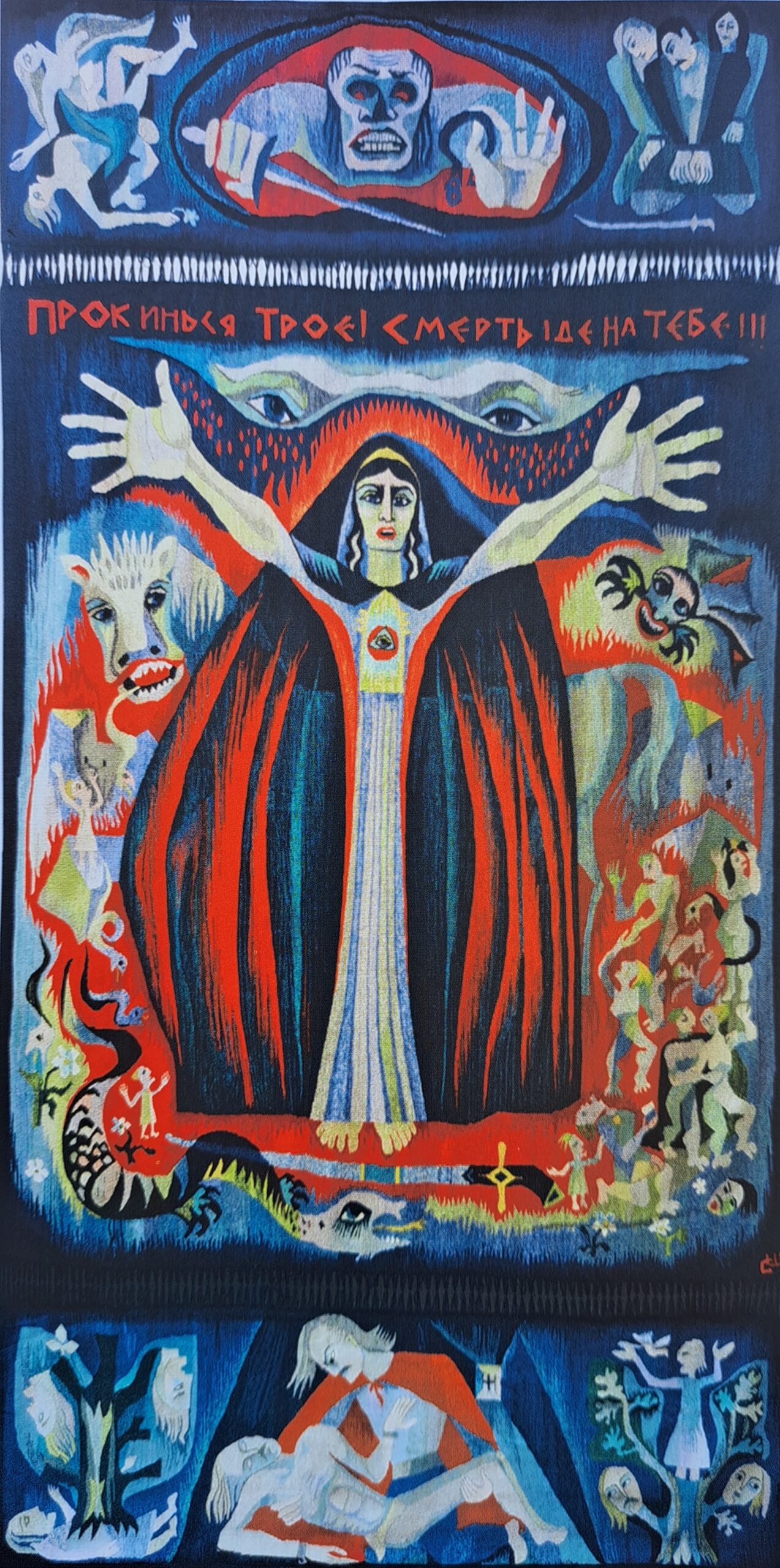
Source: Zenoviia Shulha (comp.), Textiles as Weapons: Nataliia Pauk, Oleksandra Krypiakevych, Stefaniia Shabatura, Lviv, Manuscript, 2018.
-
Lesia Ukrainka, Cassandra: A Dramatic Poem, Trans. Nina Murray, Cambridge, Harvard University Press, coll. “Harvard Library of Ukrainian Literature,” 2024.↩︎
-
Heorhii Kasianov, The Dissidents: Ukrainian Intellectuals in the Resistance Movement of the 1960s-1980s, second edition reviewed and expanded, Kyiv, Klio Publishing House, 2019.↩︎
-
Liubov Krupnyk, “Lviv artist Stefaniia Shabatura – participant in the Ukrainian dissident movement of the 1960s-1980s,” Scientific notes, vol. 16, M. S. Hrushevsky Institute of Ukrainian Archeography; Source Studies of the National Academy of Sciences of Ukraine, 2008, pp. 474–483.↩︎
-
Lorenzo Calafiore, Giulia Vitali and Lucia Pallaracci (eds.), Cassandra. Immaginari letterari e figurativi, Rome, Bretschneider Giorgio, 2023, s. p.↩︎
-
Niccolo Cecconi, “Amabili guance rosee. La ricezione della venustà di Cassandra tra Polignoto e Luciano”, in Lorenzo Calafiore, Giulia Vitali and Lucia Pallaracci (eds.), Cassandra. Immaginari letterari e figurativi, Rome, Bretschneider Giorgio, 2023, pp. 63–80.↩︎
-
Benedetta Sciaramenti, “The figure of Cassandra in Pompeian painting”, in Lorenzo Calafiore, Giulia Vitali and Lucia Pallaracci (eds.), Cassandra. Immaginari letterari e figurativi, Rome, Bretschneider Giorgio, 2023, pp. 143–157.↩︎
-
“Pompeii: A Dining Room Decorated with Characters and Subjects Inspired by the Trojan War Has Emerged from the New Excavations,” Pompeii Sites, April 2024, online, <https://pompeiisites.org/en/comunicati/pompeii-a-dining-room-decorated-with-characters-and-subjects-inspired-by-the-trojan-war-has-emerged-from-the-new-excavations/>.↩︎
-
“The Troy Myth and Reality : Exhibition. 21 November 2019 – 8 March 2020”, British Museum, <https://www.britishmuseum.org/exhibitions/troy-myth-and-reality>.↩︎
-
Lesia Ukrainka, Complete Academic Edition of the Works, vol. 2, Lutsk, 2021, p. 311. (hereafter LU).↩︎
-
Orest Holubets, “Lviv Cassandra,” in Solomiia Diakiv (ed.), Stefaniia Shabatura: The Unconquered Spirit of Creativity, Kyiv, 2017, pp. 40–44.↩︎
-
Solomiia Diakiv, Stefaniia Shabatura: The Unconquered Spirit of Creativity, Kyiv, 2017, p. 16.↩︎
-
Yaroslav Kravchenko, “Cassandra the Prophetess… In the Creative Life of Stefaniia Shabatura,” Den, issue 200-201, 2016, p. 32.↩︎
-
For details on the case of S. Shabatura, archival materials and the course of the investigation, see: “Stefaniya Shabatura”, Repressed Art, <https://art.cdvr.org.ua/?shabatura>; State Archives of the Security Service of Ukraine. Case п-3257; Liubov Krupnyk, “Lviv Artist Stefaniia Shabatura – Participant in the Ukrainian Dissident Movement of the 1960s-1980s”, loc. cit.; Olga Ihnatenko, “Lviv Artist Stefaniia Shabatura: A Contemporary View of the 1972 Criminal Case”, Ukraine: Cultural Heritage, National Consciousness, Statehood. On the 22nd Anniversary of the Restoration of Ukraine’s Independence, Lviv, 2013, pp. 631–643); Olga Ihnatenko, “Problems of Creative Adaptation of Artists of the Lviv State Institute of Applied and Decorative Arts under Totalitarianism (1940s-1960s)”, Scientific Journals of the History Faculty of Lviv University, issue 14, 2013, pp. 215–228); Solomiia Diakiv, Stefaniia Shabatura: Selected Palette of Colours from the Mosaic of Life and Creativity, Kyiv, 2016.↩︎
-
Liubov Krupnyk, “Lviv artist Stefaniia Shabatura – participant in the Ukrainian dissident movement of the 1960s-1980s”, loc. cit., p. 477.↩︎
-
Olga Ihnatenko, “The Socio-Political Position of Art Historian Volodymyr Ovsiichuk”, The Ethnology Notebooks, vol. 6, 2014, p. 1107.↩︎
-
Liubov Krupnyk, “Lviv artist Stefaniia Shabatura – participant in the Ukrainian dissident movement of the 1960s-1980s”, loc. cit., p. 477.↩︎
-
Roman Yatsiv, “The Symbolic Space of Stefaniia Shabatura’s Art”, Stefaniia Shabatura: The Unconquered Spirit of Creativity, Kyiv, 2017, pp. 45–48.↩︎
-
Orest Holubets, “Lviv Cassandra”, op. cit., p. 42.↩︎
-
Roman Yatsiv, “The Symbolic Space of Stefaniia Shabatura’s Art”, op. cit., p. 46.↩︎
-
“In Lviv, the 75th Anniversary of Stefaniia Shabatura, One of the Organizers of the Dissident Movement, Was Celebrated,” DailyLviv, November 2013, online, <https://dailylviv.com/news/kultura/u-lvovi-vidznachaly-75-littya-odnoho-z-orhanizatoriv-dysydentskoho-rukhu-stefaniyi-shabatury-1720>.↩︎
-
Roman Yatsiv, “The Symbolic Space of Stefaniia Shabatura’s Art”, op. cit., p. 46.↩︎
-
Zenoviia Shulha, “Artistic Textiles as Weapons”, Journal of the Lviv National Academy of Arts, issue 31, Lviv, 2017, p. 67.↩︎
-
Zenoviia Shulha, Textiles as Weapons: Nataliia Pauk, Oleksandra Krypiakevych, Stefaniia Shabatura, Lviv, Manuscript, 2018.↩︎
-
Diana Klochko notes a new wave of interest in textiles today, particularly through exhibitions. For more details, see: Jam Factory Art Center, Lecture from Diana Klochcko, « From Defocus to Focus », <https://www.youtube.com/watch?v=gotn-8K3wl0>.↩︎
-
Julia Bryan-Wilson, Fray: Art and Textile Politics, Chicago, The University of Chicago Press, 2017.↩︎
-
“Stefaniya Shabatura”, Repressed Art, <https://art.cdvr.org.ua/?shabatura>.↩︎
-
Olga Ihnatenko, “The Socio-Political Position of Art Historian Volodymyr Ovsiichuk”, loc. cit., p. 1108.↩︎
-
Solomiia Diakiv, Stefaniia Shabatura: Selected Palette of Colors…, op. cit., p. 103.↩︎
-
“Stefaniya Shabatura”, Repressed Art, <https://art.cdvr.org.ua/?shabatura>.↩︎
-
Orest Holubets, “Lviv Cassandra”, op. cit., p. 43.↩︎
-
Pablo Picasso, “Entretien avec Simone Téry”, Les Lettres françaises, March 24th 1945.↩︎
-
Yaroslav Kravchenko, “Cassandra the Prophetess… In the Creative Life of Stefaniia Shabatura”, loc. cit., p. 32.↩︎
-
Roman Yatsiv, “The Symbolic Space of Stefaniia Shabatura’s Art”, op. cit., p. 45.↩︎
-
Orest Holubets, “Lviv Cassandra”, op. cit., p. 43.↩︎
-
Ibid.↩︎
-
Tamara Hundorova, Lesya Ukrainka: The Sibylline Books, Kyiv, 2024, p. 255.↩︎
-
Solomiia Diakiv, Stefaniia Shabatura: Selected Palette of Colours…, op. cit., p. 10.↩︎
-
Heorhii Kasianov, The Dissidents, op. cit.↩︎
-
Tamara Hundorova, op. cit., p. 260.↩︎
-
For more details, see: Alla Horska: Art Monograph, ed. A. Yatskovska, Kyiv, 2024; Oleksii Zaretskyi, Alla Horska. An Artist in the Space of Totalitarianism, Kyiv, 2023A. Yatskovska (ed.), Kyiv, 2024.↩︎
-
Zenoviia Shulha, “Artistic Textiles as Weapons”, loc. cit., pp. 59–60.↩︎
-
Roman Yatsiv, “The Symbolic Space of Stefaniia Shabatura’s Art”, op. cit., p. 46.↩︎
-
Olena Lodzynska, “Can a Genius Be Humiliated?”, Istorychna Pravda, 2020, online, <https://www.istpravda.com.ua/articles/5f6c65d9d337c/>, accessed 10 May 2026.↩︎
-
Stefaniia Shabatura, “Statement”, Rehabilitated by History. Ternopil Region, vol. 2, Ternopil, 2012, pp. 37–38.↩︎
-
Ibid.↩︎
-
Solomiia Diakiv, Stefaniia Shabatura: Selected Palette of Colours…, op. cit., pp. 22–23.↩︎
-
Solomiia Diakiv, Stefaniia Shabatura: The Unconquered Spirit of Creativity…, op. cit., p. 17.↩︎
-
Solomiia Diakiv, Stefaniia Shabatura: Selected Palette of Colours…, op. cit., pp. 109–110.↩︎
-
I. K., “Khudozhnytsia i hromadianka (do 50-richchia Stefanii Shabatury)”, in Yevshanzillia, vol. 3, Lviv, 1988, pp. 311–315.↩︎
-
Aleida Assmann, Erinnerungsräume: Formen und Wandlungen des kulturellen Gedächtnisses, Munich, C. H. Beck, 1999.↩︎